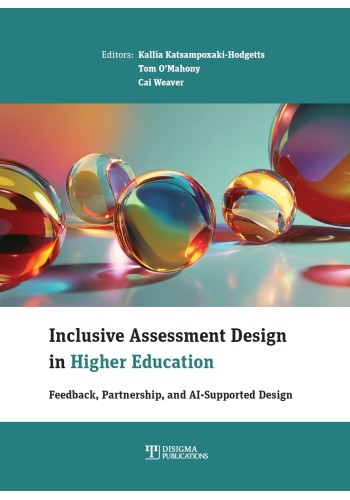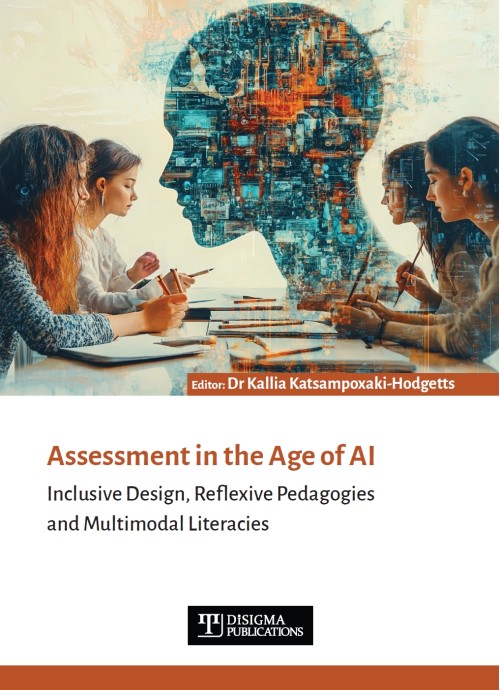
Assessment in the Age of AI
- Διαθεσιμότητα: Διαθέσιμο
- : Katsampoxaki Hodgetts Kallia
0,00€
Χωρίς ΦΠΑ: 0,00€
Κατηγορίες:
Κοινωνικές Επιστήμες, Πληροφορική


| Χαρακτηριστικά Βιβλίου | |
| Γλώσσα | Αγγλικά |
| Διαστάσεις | 21x29 xm |
| Εσωτερικό Βιβλίου | Έγχρωμο |
| Έτος Έκδοσης | 2026 |
| Σελίδες | 194 |
| ISBN | 978-618-202-347-1 |
Η ραγδαία ανάπτυξη της Τεχνητής Νοημοσύνης μετασχηματίζει τον τρόπο με τον οποίο διδάσκουμε, μαθαίνουμε και αξιολογούμε. Το βιβλίο Assessment in the Age of AI εξερευνά τις προκλήσεις και τις ευκαιρίες που αναδύονται σε αυτό το νέο εκπαιδευτικό τοπίο, προτείνοντας καινοτόμες προσεγγίσεις αξιολόγησης που ανταποκρίνονται στις ανάγκες της σύγχρονης εκπαίδευσης.
Μέσα από μια συλλογή ερευνητικών και εφαρμοσμένων κεφαλαίων, διακεκριμένοι ακαδημαϊκοί και ερευνητές εξετάζουν πώς η αξιολόγηση μπορεί να μετακινηθεί από τη μονοδιάστατη μέτρηση της επίδοσης προς μια πιο συμμετοχική, συμπεριληπτική και αναστοχαστική διαδικασία μάθησης. Ιδιαίτερη έμφαση δίνεται στη συνδιαμόρφωση κριτηρίων και ρουμπρικών αξιολόγησης με τους φοιτητές, στην αξιοποίηση πολυτροπικών μορφών έκφρασης, καθώς και στον ρόλο της Τεχνητής Νοημοσύνης ως εργαλείου υποστήριξης της μάθησης και της εκπαιδευτικής κρίσης.
Το βιβλίο διερευνά ζητήματα όπως η ανάπτυξη του AI literacy των εκπαιδευτικών, η συν-σχεδίαση διαδικασιών αξιολόγησης με τη συμμετοχή των μαθητών και της Τεχνητής Νοημοσύνης, η αξιολόγηση βασισμένη στη διαδικασία μάθησης, οι πολυτροπικές μορφές αξιολόγησης, καθώς και η καλλιέργεια αναστοχαστικής κρίσης και επαγγελματικής αυτενέργειας σε περιβάλλοντα πλούσια σε τεχνολογίες AI.
Αντί να αντιμετωπίζει την Τεχνητή Νοημοσύνη είτε ως απειλή είτε ως εύκολη λύση, το έργο προτείνει μια ισορροπημένη και κριτική προσέγγιση. Αναδεικνύει τη σημασία της ανθρώπινης κρίσης, της ηθικής ευθύνης, της συνεργασίας και της ενεργού συμμετοχής των εκπαιδευομένων στη διαδικασία αξιολόγησης, προσφέροντας πρακτικές και θεωρητικές κατευθύνσεις για το μέλλον της εκπαίδευσης.
Το Assessment in the Age of AI αποτελεί πολύτιμο ανάγνωσμα για ερευνητές, πανεπιστημιακούς διδάσκοντες, εκπαιδευτικούς όλων των βαθμίδων, σχεδιαστές προγραμμάτων σπουδών, στελέχη εκπαιδευτικών οργανισμών και όσους ενδιαφέρονται να κατανοήσουν πώς η αξιολόγηση μπορεί να επαναπροσδιοριστεί στην εποχή της Τεχνητής Νοημοσύνης.
Preface
PART I. RETHINKING ASSESSMENT IN THE AGE OF AI
Chapter 1. The End of Assessment as We Know It? AI Literacy for Teachers as Designers of Learning
Kallia Katsampoxaki-Hodgetts, Bill Cope, and Mary Kalantzis
Chapter 2. The ‘Cyber-Social’ Turn in Higher Education: Learning as Design and Implications for Assessment in EAP Contexts
Fei Victor Lim
PART II. CO-DESIGNING CRITERIA, RUBRICS, AND ASSESSMENT WITH STUDENTS AND AI
Chapter 3. Assessment as AI-Mediated Co-Design: Reconceptualizing Classroom Assessment in Pre-Service Language Teacher Education
Ferit Kılıçkaya
Chapter 4. From Teacher-Centred to Student-Partnered: Advancing Inclusive Assessment through Rubric Co-Construction
Tom O’Mahony, Con Burns, Collette Nolan, Bill O’Flynn, Thomas Broderick, Eimer Foley, Catherine Murphy, and Denise McSweeney
Chapter 5. Rubric Co-Design with Generative AI in Teacher Education: Negotiating Criteria and Authority
Juan Manuel Castro Carracedo
PART III. PROCESS-BASED, MULTIMODAL, AND AI-MEDIATED ASSESSMENT IN PRACTICE
Chapter 6. AI as a Third Voice: Co-Designed Multimodal Assessment of Pragmatic Competence in Lower Secondary EFL
Aglaia Rouki
Chapter 7. From Product to Process: Operationalising Assessment as Learning in an AI-Mediated Science Communication Course
Kallia Katsampoxaki-Hodgetts
Chapter 8. AI as an Epistemic Scaffold: Designing Assessment with AI Resources in Early Science Education
Kallia Katsampoxaki-Hodgetts, Konstantinos Kotsidis, Stamatis Papadakis, and Panagiotis Anastasiades
PART IV. REFLECTIVE ASSESSMENT LITERACIES, PROFESSIONAL AGENCY, AND COLLECTIVE SENSE-MAKING
Chapter 9. Working with the ‘Don’t Knows’ of AI-Rich Assessment: Reflexive Judgement, Practitioner Agency and Collective Sense-Making
Sonja Strydom, Hanelie Adendorff, Sukaina Walji, François Cilliers, Cheng-Wen Huang, and Soraya Lester
Author Bios
Dr Hanelie Adendorff is a senior advisor in the Centre for Teaching and Learning at Stellenbosch University, where she works in the area of academic professional development. She holds a PhD in Chemistry and has been involved in higher education teaching and learning development since 2002. Her early work focused on blended learning and the use of educational technologies, and has since expanded to include assessment, collaborative learning, science education, academic staff development, and curriculum renewal. More recently, her work has engaged with the decolonisation of the science curriculum and the implications of generative AI for teaching, learning and assessment in higher education. Across these areas, her scholarship and practice are concerned with creating meaningful learning opportunities, supporting academics in reflective curriculum and assessment design, and strengthening students’ access to disciplinary knowledge and participation.
Panos Anastasiades is Professor of Lifelong and Distance Learning with the use of Information and Communication Technologies in the Department of Primary Education at the University of Crete. He is the founder and director of the Laboratory for Advanced Learning Technologies in Lifelong and Distance Education (eLearning Lab) and founder and director of the postgraduate programme Educational Sciences - Distance Education using ICT. His research focuses on the pedagogical use of advanced digital technologies, including human-centred artificial intelligence, social media, digital storytelling and augmented reality, to support collaborative creativity, critical thinking and safe participation in digital environments. He has designed and led large-scale initiatives in school distance education and teacher professional development, including the long-running ODYSSEAS programme linking schools in Greece and Cyprus. His extensive publication record addresses e-learning, lifelong learning, teacher education, collaborative learning and technology-enhanced educational innovation.

Juan Manuel Castro Carracedo is Full Professor in the Faculty of Education at the Pontifical University of Salamanca, Spain. He holds a PhD in English Philology and a degree in Hispanic Philology, with further postgraduate training in linguistics, literature and language teaching. He has served as Vice-Rector for Internationalisation and Student Affairs and as Vice-Dean of the Faculty of Education at the same university. His current work focuses on English language teacher education, assessment literacy, the internationalisation of education, global competences, and the pedagogical implications of educational technology and generative AI. He leads and participates in research initiatives on 21st-century skills and innovation in higher education, including the GLOBES21 Research Group and several Erasmus+ projects. His recent publications examine inquiry-based learning, critical thinking, English language teacher education, digital resources for second-language learning, and the integration of human-centred pedagogical approaches in university teaching.

Bill Cope is a Professor in the Department of Education Policy, Organization & Leadership, University of Illinois, Urbana-Champaign and a leading scholar in the fields of literacy and technology-mediated learning. His recent research has focused on the development of AI-supported digital writing and assessment technologies. He has led the development of CGScholar and CyberScholar platforms with the support of grants from the US Department of Education, the Bill and Melinda Gates Foundation, and the National Science Foundation.

Mary Kalantzis was from 2006 to 2016 Dean of the College of Education at the University of Illinois, Urbana-Champaign. Before this, she was Dean of the Faculty of Education, Language and Community Services at RMIT University, Melbourne, Australia, and President of the Australian Council of Deans of Education. She has co-authored with Bill Cope: “New Learning: Elements of a Science of Education,” Cambridge University Press, 2008 (2nd edition, 2012); “Literacies,” Cambridge University Press 2012 (2nd edition, 2016); the two volume grammar of multimodal meaning: “Making Sense” and “Adding Sense,” Cambridge University Press, 2020, and (with Zapata and Cope), and “Literacies in the Age of AI: Teaching and Learning in the Digital Era,” Wiley, 2026.

Kallia Katsampoxaki-Hodgetts is a lecturer in educational assessment, and multiliteracies in science teacher education, science communication and academic writing at the University of Crete. She is also a postdoctoral researcher in multiliteracies and multimodality at the University of Ioannina, Greece. Her research focuses on Learning by Design, inclusive assessment, student voice, civic engagement, and the role of digital innovation in science communication. She has coordinated and contributed to faculty development initiatives on inclusive student-centred pedagogy, assessment literacy, and reflective curriculum design in higher education. She has authored papers and chapters on assessment, multiliteracies, and inclusive curricula, with recent work examining how teachers and students use AI tools, multimodal artefacts, and reflective practices to make learning, evaluative judgement, and participation more visible. Her scholarship connects theory, process-based and inclusive pedagogy, and practice across contexts from pre-school education to higher education.

Ferit Kılıçkaya is a researcher in Teaching English as a Foreign Language at Burdur Mehmet Akif Ersoy University, Türkiye. He holds MA and PhD degrees in TEFL from Middle East Technical University. His research focuses on the integration of technology into language teaching and learning, with particular attention to its pedagogical affordances and potential challenges. His scholarly interests also include language testing and assessment, especially peer feedback, online quizzes, washback and the use of emerging technologies to enhance teaching, learning and assessment practices. He has published extensively in international peer-reviewed journals and has authored numerous book chapters for international publishers. His research contributes to technology-enhanced language education and evidence-based assessment practices, with particular emphasis on teaching effectiveness, learner outcomes and the informed integration of emerging technologies into language education.

Konstantinos Kotsidis is a university lecturer in the postgraduate programme Educational Sciences - Distance Education using ICT at the University of Crete and an Academic Advisor at the Hellenic Open University. He is also a scientific collaborator of the Laboratory for Advanced Learning Technologies in Lifelong and Distance Education (eLearning Lab) and an Education Advisor in primary education. He holds a PhD in Education from the University of Crete and is conducting postdoctoral research on the human-centred pedagogical use of artificial intelligence in primary education. His research interests include educational technology, instructional design for distance learning, teacher professional development, social learning environments and artificial intelligence in K-12 education. His recent work examines how AI can function as a pedagogical collaborator while preserving human agency, critical thinking, creativity, inclusion and ethical judgement. He has participated in national and international research projects and has published in peer-reviewed journals and conference proceedings

Fei Victor Lim is Associate Professor and Deputy Head (Research) in English Language and Literature at the National Institute of Education, Nanyang Technological University, Singapore. His research and teaching focus on multiliteracies, multimodal discourse analysis, and digital learning. He serves as an Editor of Multimodality and Society and Associate Editor of Computers and Composition. He leads the Literacies Research Group at NIE and MERLIN (Multimodality in Educational Research and Learning International Network) comprising a community of researchers and practitioners interested in multimodality and learning. He has been recognised among the top 2% of scientists worldwide in Education and in Language and Linguistics (2023–2025) in a study conducted by Stanford University, and has received awards for excellence in research, teaching, and service.

Tom O’Mahony is affiliated with the Department of Electrical and Electronic Engineering at Munster Technological University. He coordinates the BEng (Hons) in Electronic Engineering and manages several EU Erasmus+ research projects. He also works with the Teaching and Learning Unit, where he coordinates and teaches on the Master of Arts in Teaching and Learning in Higher Education. Within this role, he designs and leads staff professional development initiatives at MTU related to active learning, assessment and educational research. He is Principal Investigator of the Teaching, Learning, Assessment and Student Engagement Research Laboratory at MTU. His research interests include active learning, particularly flipped, project-based and problem-based learning, assessment and feedback, and engineering education. He has published more than 70 peer-reviewed works, supervises two PhD candidates and peer-reviews for several educational research journals.
Kallia Katsampoxaki-Hodgetts is a lecturer in educational assessment, and multiliteracies in science teacher education, science communication and academic writing at the University of Crete. She is also a postdoctoral researcher in multiliteracies and multimodality at the University of Ioannina, Greece. Her research focuses on Learning by Design, inclusive assessment, student voice, civic engagement, and the role of digital innovation in science communication. She has coordinated and contributed to faculty development initiatives on inclusive student-centred pedagogy, assessment literacy, and reflective curriculum design in higher education. She has authored papers and chapters on assessment, multiliteracies, and inclusive curricula, with recent work examining how teachers and students use AI tools, multimodal artefacts, and reflective practices to make learning, evaluative judgement, and participation more visible. Her scholarship connects theory, process-based and inclusive pedagogy, and practice across contexts from pre-school education to higher education.