
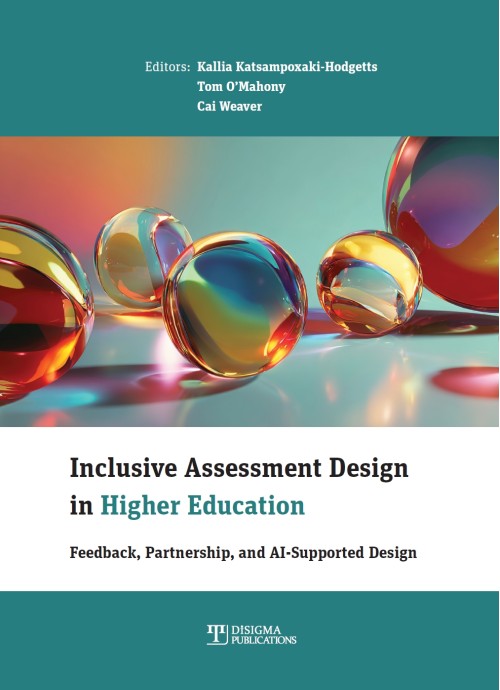
Inclusive Assessment Design in Higher Education
- Διαθεσιμότητα: Διαθέσιμο
- : Katsampoxaki Hodgetts Kallia , O'Mahony Tom , Weaver Cai
0,00€
Χωρίς ΦΠΑ: 0,00€




Kallia Katsampoxaki-Hodgetts is a lecturer in educational assessment, and multiliteracies in science teacher education, science communication and academic writing at the University of Crete. She is also a postdoctoral researcher in multiliteracies and multimodality at the University of Ioannina, Greece. Her research focuses on Learning by Design, inclusive assessment, student voice, civic engagement, and the role of digital innovation in science communication. She has coordinated and contributed to faculty development initiatives on inclusive student-centred pedagogy, assessment literacy, and reflective curriculum design in higher education. She has authored papers and chapters on assessment, multiliteracies, and inclusive curricula, with recent work examining how teachers and students use AI tools, multimodal artefacts, and reflective practices to make learning, evaluative judgement, and participation more visible. Her scholarship connects theory, process-based and inclusive pedagogy, and practice across contexts from pre-school education to higher education.
Tom O’Mahony is affiliated with the Dept. of Electrical and Electronic Engineering at Munster Technological University. He coordinates the BEng. (Hons) in Electronic Engineering and manages several EU Erasmus+ research projects. He also works with the Teaching and Learning Unit (TLU) where he coordinates and teaches on the Master of Arts in Teaching and Learning in Higher Education. With the TLU, he is responsible for designing and leading staff professional development initiatives at MTU related to active learning, assessment and educational research. He is the Principal Investigator for the Teaching, Learning Assessment and Student Engagement (TLASE) Research Laboratory at MTU. His research interests include active learning, especially flipped, project and problem-based learning, assessment and feedback, and engineering education. Tom has over 70 peer-reviewed publications, is supervising two PhD candidates and peer-reviews for several educational research journals.
Cai Weaver is a Language Specialist at the South-Eastern Finland University of Applied Sciences (Xamk), where he supports academic writing, international publishing, and open educational resources. His work focuses on developing researchers’ professional identity and skills through initiatives such as the Scientific Writing Coaching programme. He is actively involved in the INGENIUM European University alliance, working on supporting staff pedagogical development, micro-credentials, and lifelong learning initiatives. His interests include inclusive writing and publishing, feminist pedagogy and theory, and the role of power and identity in academic knowledge production and teaching. He has published on LGBTQIA+ activism, the development of scientific publishing support processes, and micro-content and micro-learning.
ORCID iD: https://orcid.org/0000-0002-4777-6661